Organizations as Runtime Systems
From Forward Deployed Engineers to Autonomous Operations
For years, enterprise software promised abstraction.
Platforms, APIs, integrations, and dashboards were supposed to standardize operations and reduce organizational complexity. Yet large enterprises continued to depend on a different mechanism to make software actually work in production environments: embedded human coordination.
This is the environment in which the Forward Deployed Engineer emerged.
Companies like Palantir understood something early that much of the software industry underestimated: enterprise problems are rarely isolated technical problems. More often, they are operational coordination problems that happen to manifest through software.
The difficult part was never simply exposing APIs or shipping configurable platforms. The difficult part was translating ambiguous, constantly evolving organizational workflows into executable systems that could survive contact with reality.
FDEs became the bridge between software platforms and operational execution. More importantly, they became a coordination layer embedded directly into the organization itself.
Agentic systems are now beginning to inherit that role.
The Original Role of the FDE
The industry often describes Forward Deployed Engineers as customer-facing engineers, deployment specialists, or integration consultants. That framing misses what made the role strategically important.
FDEs existed because organizations behave less like static hierarchies and more like distributed systems operating under continuous partial inconsistency. Priorities shift, ownership changes, information arrives asynchronously, and operational workflows evolve faster than software abstractions can adapt.
Traditional enterprise platforms struggled because they assumed the organization itself was stable. In reality, most enterprise environments are defined by coordination overhead.
The real responsibility of the FDE was therefore not integration, but orchestration.
An effective FDE continuously translated fragmented workflows, conflicting operational requirements, and evolving business constraints into executable processes that software systems could reliably support. They coordinated across teams, stabilized execution under changing operational conditions, interpreted policy in operational context, and closed the gap between platform abstractions and organizational reality.
In practice, FDEs became a runtime layer for the organization itself.
Why Enterprise Software Needed Human Orchestration
Classical enterprise software optimized for standardization and repeatability. Organizations, however, rarely operate in such controlled conditions.
Large enterprises resemble distributed systems much more closely than traditional software diagrams suggest. Communication is asynchronous. State is inconsistent. Failures are partial. Retries are common. Decision-making is delayed. Multiple actors operate with incomplete context simultaneously.
Human operators compensated for this mismatch.
Forward Deployed Engineers became operational coordinators embedded directly inside execution flows. They routed escalations, reconciled conflicting state between teams, adapted workflows under changing operational conditions, and continuously stabilized execution where platform abstractions alone were insufficient.
Humans resolve ambiguity exceptionally well because they generalize dynamically across incomplete information and shifting operational context. But human coordination scales poorly for the same reason tightly coupled distributed systems do: every additional workflow, dependency, and organizational boundary increases coordination overhead non-linearly.
Over time, enterprises accumulated growing layers of embedded operational engineering simply to maintain execution consistency across increasingly complex systems.
Agentic Systems Change the Equation
Large language models introduced a fundamentally new capability into software systems: dynamic operational reasoning.
For the first time, software systems could interpret intent, navigate incomplete information, invoke tools, adapt execution paths dynamically, and coordinate actions across previously disconnected systems.
This is why agentic systems represent more than another interface layer on top of existing software.
The important shift is not conversational AI. The important shift is that execution itself is becoming programmable.
Protocols such as MCP, structured tool invocation systems, workflow runtimes, and AI-native orchestration platforms are transforming models from passive reasoning systems into operational actors capable of participating directly inside organizational workflows.
The architectural importance of protocols in this transition is difficult to overstate.
A model capable of reasoning is interesting. A model capable of participating safely inside operational workflows is transformative.
That distinction depends on protocols.
Systems like MCP matter not because they make tool invocation possible, but because they standardize execution boundaries between autonomous actors and external systems. Once tool access becomes structured, state becomes explicit, permissions become enforceable, and workflow transitions become observable, autonomous execution stops being a collection of isolated demos and starts becoming composable infrastructure.
In that sense, protocol layers for agentic systems are beginning to play a role similar to what HTTP played for distributed services: they define a common operational surface across which independently evolving systems can coordinate execution predictably.
The Reliability Problem
Most current AI systems still inherit assumptions from conversational interfaces. They rely heavily on hidden context, implicit memory, opaque reasoning, and non-repeatable execution patterns.
Those characteristics are acceptable for consumer assistants. They are dangerous for operational systems.
The moment AI systems move from suggestion into execution, reliability becomes the central engineering problem.
Operational environments require explicit workflow state, bounded permissions, resumable execution, auditability, deterministic transitions, and observable behavior under failure conditions. Organizations cannot depend on systems that behave unpredictably across identical operational scenarios.
This is where much of the current agent hype collides with reality.
Autonomous execution introduces distributed systems problems almost immediately:
- partial completion
- inconsistent state
- retry storms
- unsafe tool invocation
- conflicting workflow transitions
- deadlocks between approval systems and autonomous actors
The architecture required to solve these problems looks significantly less like chatbot design and much more like distributed systems engineering.
Operational Runtime Engineering
This transition is creating a new engineering discipline.
Not prompt engineering. Not classical integration engineering. Not simply DevOps or platform engineering.
The emerging problem space is operational runtime engineering: the design of systems capable of safely coordinating autonomous execution inside real organizations.
Where SRE focuses primarily on infrastructure reliability and platform engineering focuses on developer abstractions, operational runtime engineering focuses on execution semantics for organizational systems themselves.
The core challenge is no longer simply deploying software. It is designing operational runtimes that remain governable under conditions of dynamic autonomous execution.
That requires explicit orchestration models, durable workflow state, bounded execution permissions, role separation between autonomous actors, human approval systems, policy enforcement layers, execution observability, and deterministic recovery paths under failure conditions.
The artifacts also begin to change. Instead of isolated APIs and service boundaries, engineers increasingly design execution graphs, workflow state machines, review pipelines, policy runtimes, orchestration protocols, and human-agent coordination models.
A deployment workflow, for example, increasingly resembles a distributed execution pipeline rather than a sequence of human-operated steps:
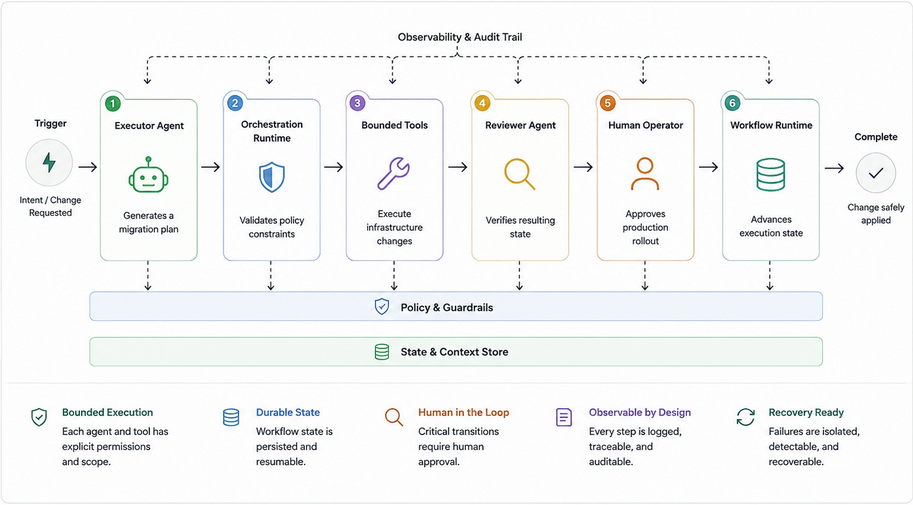
Operational runtimes coordinate autonomous actors through explicit state, bounded execution, and governable workflow transitions.
This is fundamentally different from traditional automation.
Classical automation executes predefined procedures. Operational runtimes coordinate autonomous actors operating under bounded but dynamic execution conditions.
That distinction becomes increasingly important as workflows grow longer-running, more stateful, and more organizationally coupled.
Most current agentic systems remain immature in this regard. They are optimized for generating locally impressive behavior rather than supporting reliable operational execution over extended workflows.
Operational systems, however, are not judged by how intelligently they behave under ideal conditions. They are judged by how predictably they recover under imperfect ones.
Organizations as Runtime Systems
The deeper shift is that organizations themselves are becoming programmable execution environments.
Historically, software primarily modeled information while humans coordinated operations manually around it. Increasingly, software systems are beginning to model operational processes directly: approvals, escalations, investigations, migrations, reviews, deployments, compliance flows, coordination paths, and organizational decision-making itself.
Tasks become executable workflows. Agents become operational workers. Humans increasingly act as reviewers, governors, and escalation authorities inside larger orchestration systems.
The architecture starts looking less like traditional enterprise software and more like a distributed runtime environment operating across humans, agents, workflows, and policy systems simultaneously.
This changes the role of enterprise engineering fundamentally.
The challenge is no longer merely building platforms. The challenge is designing operational runtimes capable of coordinating autonomous execution safely under real organizational complexity.
The systems that succeed will not be the most autonomous.
They will be the most governable.
Conclusion
Forward Deployed Engineering was never fundamentally about integrations.
It was about embedding execution into operational reality.
Agentic systems are now extending that idea further: from embedded engineers to embedded autonomy.
But autonomy without structure does not create leverage. It creates operational instability.
The next generation of enterprise AI will therefore not be defined primarily by conversational interfaces or isolated model capability. It will be defined by orchestration, governance, recoverability, and execution reliability under real operational conditions.
In practice, the future of enterprise AI will increasingly resemble distributed systems engineering applied to organizations themselves.
Originally published on GitHub — engineering-notes/organizations-as-runtime-systems.md.